Salesforce Agentforce: Architecture, Implementation and Business Impact
Agentforce, the agentic AI-powered solution from Salesforce, enables organizations to build, deploy and manage autonomous agents to perform a wide variety of tasks across departments and teams.
April 21, 2026 | By Nandhakumar Thangavelu & Raj Bansal
All major enterprise platforms—including Salesforce, ServiceNow Oracle Cloud Infrastructure, Workday and SAP—have developed and delivered agentic AI capabilities over the past few years. Salesforce’s Agentforce offers unique capabilities that help teams reduce administrative burdens and maximize data as an asset.
In this article, we’ll explore the capabilities and attributes of Agentforce, as well as a potential use case and high-level architecture.
What Is Salesforce Agentforce?
In 2024 Salesforce launched Agentforce, an advanced AI platform designed to help users build, deploy and manage autonomous agents capable of executing tasks across departments, including sales, service delivery, marketing and commerce.
Powered by real-time data and deeply integrated with Salesforce Customer 360, Agentforce agents operate across workflows, applications and channels—augmenting teams and driving productivity at scale.
Agentforce’s intelligent agents:
-
Learn, reason and act autonomously
-
Take on repetitive, time-consuming tasks so teams can focus on high-value activities
-
Integrate seamlessly with Salesforce Customer 360 and external applications
-
Use real-time data from Salesforce Data 360
-
Execute tasks across workflows, applications and channels
5 Main Attributes of Agentforce Implementation
To successfully implement Agentforce in your enterprise, you must understand its core building blocks. Each agent is organized around a topic—the specific task it’s designed to complete.
Every topic follows a defined set of instructions that guide the agent’s behavior and determine which action to take. These actions can leverage native Salesforce capabilities or invoke prompt templates to perform the task, ensuring work is completed consistently and within established guardrails.
The five main attributes of Agentforce include:
-
Role: the specific job or task the agent is designed to deliver
-
Knowledge: the data and context the agent draws on to perform its work
-
Actions: the steps the agent takes to complete the task
-
Guardrails: the rules, policies and constraints that govern how the agent operates
-
Channel: the environment where the agent performs its work—such as web, mobile, social media platforms, etc.
Agentforce Implementation Use Case: Sales Automation
While sales teams are often bogged down with administrative work, generative AI can eliminate that overhead, enabling sellers to focus on customer relationships, which improves conversion rates and deal velocity.
Agentforce can also eliminate manual effort by transforming Salesforce data into tailored sales content, helping your sales team engage prospects with the right message at the right time.
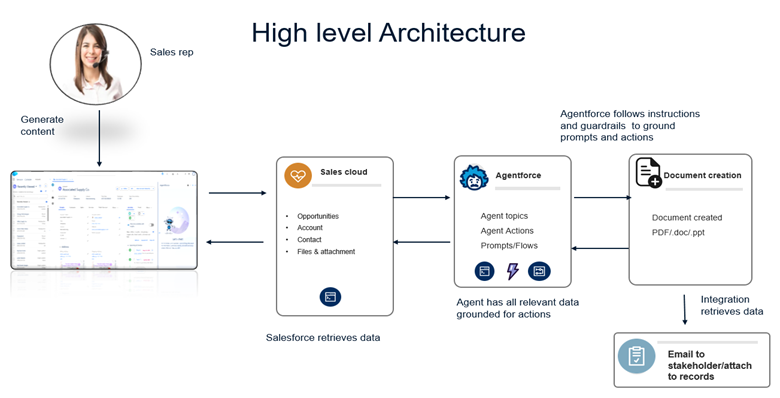
A high-level architecture for sales content creation may involve:
-
Automating content creation
-
Establishing strict guardrails
-
Validating generated content with human oversight
-
Sending the content directly to stakeholders
The benefits of implementing Agentforce in the sales process include:
-
Reduced time spent on content creation, allowing sellers to focus on closing deals
-
Aligned, data-driven messaging based on real-time Salesforce insights
-
Personalized and contextually relevant content that improves engagement and accelerates deal progression
-
Optimized CRM utilization, enabling sales teams to maximize the value of existing Salesforce data by turning it into actionable sales assets
-
Standardized and automated content generation, making it easier to scale best practices across the organization
-
Compliance with legal and regulatory requirements when creating documents
Key Takeaways: The Power of Salesforce Agentforce
Implementing Agentforce requires more than understanding the platform’s building blocks—it demands the right foundation for agentic AI solutions at scale. Strong data governance is critical, along with continuous validation and testing to measure agent performance and improve accuracy over time.
Clearly defined guardrails ensure agents operate within established boundaries and perform only the tasks they’re intended to handle. Perhaps most important of all is human-in-the-loop oversight, which remains best practice for monitoring agent behavior and ensuring generated outputs are free from toxicity or error.


Maximize Your Technology Investments
Key platform decisions, countless configuration options and far-reaching technology implications are challenges for even the most sophisticated companies. Our full-stack expertise transforms your goals into measurable results so you choose well, navigate the landscape and avoid pitfalls.