Multi-Agent AI Systems: Evolving From Microservices to Modular Intelligence
Expand your enterprise into the world of agentic AI by shifting from microservices to multi-agent AI systems.
April 3, 2026 | By Arvind Sambaraj
For the last decade, CTOs have been told that the monolith is the enemy—prompting the breakdown of massive, brittle applications into agile microservices. Today, a new monolith emerges: the large prompt.
If you’re building enterprise AI by trying to fit 20-page system instructions into a single large language model (LLM) call, you’re repeating a familiar architectural failure. You’re not building an agent—you’re building a cognitive monolith.
How Multi-Agent AI Mirrors Microservices Architecture
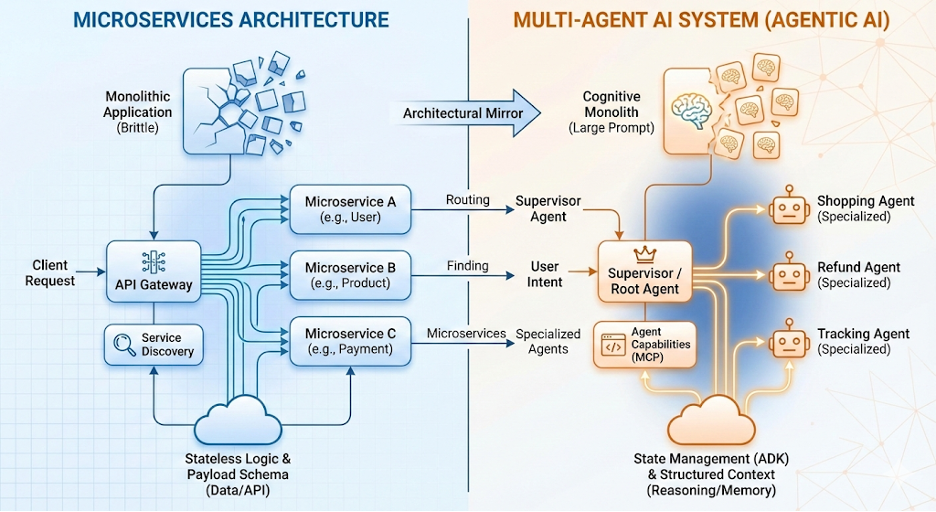
The secret to scaling AI isn’t a bigger model—it’s modularity. When we look at Google’s Agent Development Kit (ADK) and Customer Experience Agent Studio (CX Agent Studio), the parallels to microservices are unmistakable.
This comparison maps familiar microservices architecture concepts to their modern equivalents in agentic AI systems:
| Microservices Concept | Agentic AI Equivalent | Why It Matters |
|---|---|---|
| Service Discovery | Agent Capabilities (Model Context Protocol) | Agent uses protocols like the Model Context Protocol (MCP) to find and call tool/agents. |
| API Gateway | Supervisor / Root Agent | A lead agent routes user intent to the specialized “sub-agent” best fit for the task. |
| Stateless Logic | State Management (ADK) | Tools like Google’s Agent Engine manage “sessions” so agents remain lightweight and scalable. |
| Payloads and Schema | Structured Context | ADK treats context as “compiled views” rather than a messy string of text. |
It highlights not just what changes in an agent driven world but why it matters—showing how principles like service discovery, routing, statelessness and structured contracts translate into more reliable, scalable and governable AI systems.
Google ADK: Modular AI in Practice
Rather than deploying a single, all-purpose support bot, Google’s CX Agent Studio enables a system of specialized agents (e.g., shopping agents, tracking agents and refund agents), each designed for a distinct role within the customer journey. This mirrors how modern applications evolved beyond monoliths into purpose built microservices.
Just like a microservice, each agent:
-
Operates within a bounded context—narrowly focused on a specific task
-
Communicates through well-defined contracts—it accepts structured inputs and produces structured outputs
-
Scales and evolves independently—high-stakes agents that run on advanced reasoning models
The result is an AI system that is more modular, governable and scalable, avoiding the brittleness of a single, monolithic prompt in favor of an architecture built for real enterprise complexity.
Business Value of Modular Agentic AI Systems
The shift to modular agentic frameworks solves the three largest challenges in AI production:
-
Debugging: When an AI fails, you can isolate the specific agent or tool that hallucinated—just like you’d isolate a failing service.
-
Security: You can apply role-based access control (RBAC) to specific agents. Your public chat agent doesn’t need (and shouldn’t have) the API keys for your internal database agent, for example.
-
Cost: Small, specialized agents require fewer tokens and can run on smaller models, cutting your inference bills.
From Microservices to Multi-Agent AI: Your Next Step
If your organization has already invested in a mature microservices architecture, the foundation for an agentic enterprise is largely in place. APIs naturally become the tools your agent invokes.
Event buses and workflows serve as triggers that coordinate action. And, critically, your architects already understand the core patterns—bounded context, loose coupling and independent evolution—that make complex systems scalable and resilient.
The implication for technology leaders is clear: The bottleneck is no longer model capability. It’s system design. Enterprises that treat AI as a prompt engineering exercise will recreate the same fragility they once worked to eliminate. Those that apply proven architectural thinking will create systems that are adaptable, governable and built to scale.
Stop engineering prompts. Start engineering systems of intelligence.

Maximize Your Technology Investments
Key platform decisions, countless configuration options and far-reaching technology implications are challenges for even the most sophisticated companies. Our full-stack expertise transforms your goals into measurable results so you choose well, navigate the landscape and avoid pitfalls.