Designing a Global Agentic AI Platform With Google Cloud Network Connectivity Center
Agentic AI transforms enterprise architecture. Google Cloud Network Connectivity Center (NCC) provides the foundation for secure communication across enterprise resources.
September 1, 2026 | By Semir Festikj
Enterprises are entering the next phase of AI adoption. They’re building agentic AI platforms where specialized agents, tools, data sources, models and business applications work together across organizational and technology boundaries.
To operate effectively, these platforms require secure, low-latency and governed connectivity between cloud and on-premises environments while ensuring business units remain isolated and enterprise services are privately accessible. By unifying independent networks into a centrally governed network fabric, Google Cloud’s Network Connectivity Center (NCC) enables secure access to the data, services and applications that power agentic enterprise at scale.
The Challenge: Integration With Security and Governance
Imagine a global enterprise building an agentic AI platform on Google Cloud. Business units across Europe, North America and Asia need the flexibility to develop specialized agents while leveraging shared capabilities such as model inference, agent APIs and retrieval-augmented generation (RAG). Yet the enterprise systems remain distributed across regions, cloud providers and on-premises environments.
This creates a growing need for unified network management. The challenge: connecting independent networking domains while maintaining security, governance and operational simplicity.
Traditional hub-and-spoke and shared VPC architectures remain effective for many environments. However, as organizations expand, network architecture becomes another platform that must be designed, governed and operated. NCC changes the conversation, elevating the architecture to a strategic platform capability.
Organizations must move beyond managing individual network connections toward operating a unified network fabric.
High-Level Architecture
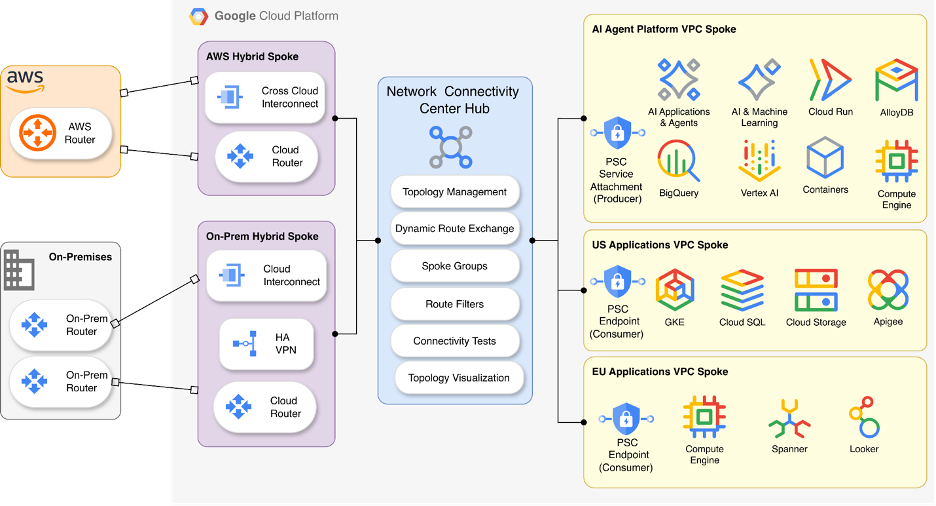
A high-level agentic AI consists of a globally distributed AI platform hosted in Google Cloud, regional business unit VPCs, and enterprise systems distributed across on-premises data centers. These environments don’t rely on an expanding web of VPNs and peering relationships; they participate in a single NCC hub as governed spokes.
This approach separates application ownership from network management. Business units remain flexible to manage their own VPCs, while the networking team governs how those networks communicate through NCC.
Topology Selection
One of the first design decisions when developing a global agentic AI platform is determining how participating networks communicate.
NCC provides multiple network topologies, each designed for a different networking model:
- Star topology, similar to a traditional hub-and-spoke network architecture, supports multi-tenant environments where business units consume centrally managed AI services but should not communicate directly with one another.
- Mesh topology operates in trusted environments that require direct connectivity. Regional AI platforms, shared engineering services or globally distributed application environments can exchange routes directly without introducing additional peering relationships.
- Hybrid inspection topology enables organizations that require centralized security inspection between AI workloads and enterprise systems. Agent requests destined for on-premises, AWS or Azure environments are routed through dedicated VPCs, allowing infrastructure teams to enforce consistent security policies and compliance controls befoe requests reach sensitive applications.
Unified Multicloud Architecture
While the AI platform runs in Google Cloud, the enterprise services consumed by AI agents remain distributed across independently managed networking domains.
NCC brings these environments into the same connectivity domain through hybrid spokes, delivering hybrid cloud connectivity without managing independent networking solutions for every cloud provider and data center. As new regions or cloud environments are introduced, they become additional spokes rather than new networking projects.
Dynamic Route Exchange
Global enterprises constantly evolve. They deploy new VPCs, introduce new cloud environments and expand locations, and each change requires routing updates across multiple networking components.
NCC simplifies this process through dynamic route exchange, automatically propagating approved routes between participating spokes according to the selected topology. The result: a connectivity model that scales operationally as the platform grows.
Network Segmentation
The future of enterprise AI depends on balancing openness with control. As the number of AI agents grows, organizations need to collaborate without sacrificing governance. Through spoke groups and route filters, NCC allows infrastructure teams to control which routes are exchanged between participating networks.
Organizations can limit access to only the services each workload requires, eliminating the need to expose entire enterprise networks. This extends the principle of least privilege beyond identity management and into the network architecture itself.
Publishing AI Services
Business units should consume AI capabilities, not the underlying AI platform network. Private Service Connect enables agent APIs, RAG services and model gateways to be published through private endpoints, while the producer VPC remains isolated. This allows teams across regions to consume centrally managed AI capabilities without requiring direct network access to the AI platform itself.
The Outcome
By combining topology selection, hybrid connectivity, dynamic route exchange, network segmentation and Private Service Connect, NCC transforms networking from a collection of individual connections into a governed connectivity platform. These powerful tools enable organizations to scale agentic AI across business units, cloud providers and geographical regions without continuously redesigning the underlying network architecture.
Building Governed Connectivity for Your Enterprise’s Agentic AI Platform
NCC is the foundation for enterprise agentic AI. Instead of managing individual VPNs, peering relationships and hybrid connections, organizations manage a single domain where VPCs, cloud providers and on-premises environments participate as governed spokes.
With NCC, they can build scalable, secure and globally distributed agentic AI platforms without continuously redesigning their network architecture. As agentic AI continues to expand across regions, clouds and business units, centralized connectivity becomes just as important as the models powering the agents themselves.

Maximize Your Technology Investments
Key platform decisions, countless configuration options and far-reaching technology implications are challenges for even the most sophisticated companies. Our full-stack expertise transforms your goals into measurable results so you choose well, navigate the landscape and avoid pitfalls.