Building an AI Ecosystem Strategy
VERSION NEXT, NOW
How Leaders Cultivate Value in AI Investments
The Change Agent
Technology leaders are looking ahead with a holistic AI ecosystem strategy, investments and governance initiatives to facilitate AI adoption, value and business success.
How Do Technology Leaders Grow a Governed AI Ecosystem Strategy?
An AI ecosystem strategy is a coordinated, organisation-wide framework that aligns AI investments, governance structures, enterprise architecture and operating models. This strategy ensures people, processes and technology work in sync to deliver measurable business value at scale.
Converting AI’s potential into tangible business value is challenging, but leading adopters who have stayed ahead are delivering measurable business value from their AI investments. They accomplish this with a AI strategy that centres on discipline, governance and intentional experimentation. AI investments need alignment with the organisation’s business transformation goals to create value and drive ROI.
Rather than unleashing the latest AI tools with ungoverned AI solutions, enterprises should develop an ecosystem that supports a synchronised strategy, meaningful governance, a modern enterprise architecture and a thoughtful AI operating model. Anchoring a holistic strategy to appropriate governance measures can ensure adoption across the workforce remains safe and secure.
Becoming an “AI-native” organisation requires intentional strategy grounded in modern enterprise architecture, synchronising people, processes and technology. Technology leaders initiate this by thoughtfully assessing how the organisation can implement AI with a streamlined operating model for various roles (product owners, data leaders, enterprise architects, etc.). In addition, they consider how portfolio processes govern intake and manage scaling and how platform choices support standardisation, reuse and compliance. Cross-functional collaboration, beyond localised success and optimisation, is critical to keeping the ecosystem permanently tethered to business value.
Organisations report that 88% of digital transformation initiatives failed to achieve the desired business goals. They invested millions in transformations, and only 12% achieved the original ambition.1 Organisational alignment and big-picture planning are the keys to avoiding this mishap, especially with technology like AI. Companies that align AI investments with business goals, technology strategy and disciplined governance will be best positioned to rapidly adopt AI at scale, realise the targeted ROI, and grow quickly and significantly.
Building a Scalable AI Ecosystem
- Identify domains and value streams in which AI can bring the most value to the organisation.
- Establish an AI operating model that balances modernisation and risk management (AI council, CoE/CoP, federated delivery).
- Strengthen data, technology foundations and accelerators to make AI outcomes rapid and repeatable.
- Balance governance and risk to maintain velocity and innovation without compromising compliance.
- Prioritise use cases based on measurable business impact; every pilot must map to ROI and a go/no-go value gate.
- Invest in people and their adoption of tools using lean change management techniques: Discover, launch, establish and scale.
Customer confidence in any service or technology rests on trust, accountability and value delivery. By tackling these issues holistically, designing the infrastructure and operating model to adapt to the rapidly changing business and technology environment, organisational leaders are more likely to achieve long-term success. Their approach isn’t about fear but preparation that enables organisational systems to adapt as rapidly as AI technology and solutions evolve. A well-aligned strategy and governance model supports and mobilises the AI ecosystem, translating discipline and intentionality into measurable business outcomes and real ROI.

TEKsystems’ State of Digital Transformation 2026 found that 71% of organisations plan to increase AI spending this year, yet only 24% have achieved full enterprise-wide implementation. This gap between intent and execution is precisely where a structured AI ecosystem strategy proves its value.

Our Perspective
Discover how businesses develop and maintain an AI ecosystem strategy and governance to build customer confidence, drive ROI and continue forging ahead of the competition.
The 10x Enterprise
Every value stream. Every role. One compounding outcome.
1. Sales and Presales
2. Service Delivery
3. Engineering
4. Operations
5. Services and Innovation
6. Data and Analytics
7. People and Talent
8. Finance and Planning
9. Client Success
10. Strategy and Growth

The Enterprise Multiplier

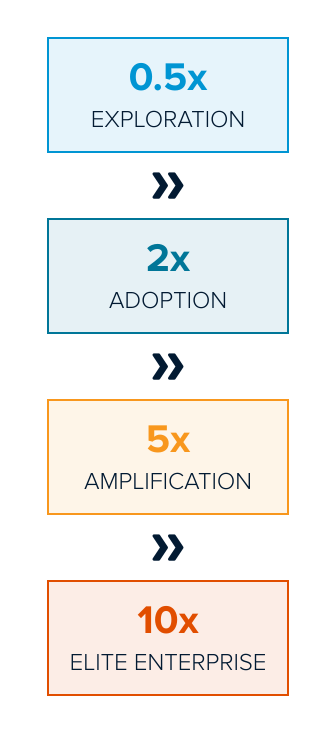
AI augmentation isn’t instant—it compounds. The right technology stack and change strategy at each stage is what separates 10x organisations from the rest.
Create an AI strategy to access value—the entry point to ecosystem strategy:
- Identify where artificial intelligence can deliver the greatest value across the enterprise and focus efforts accordingly.
- Ensure artificial intelligence investments align with strategic objectives and are supported by a robust business case with measurable return on investment.
- Prioritise efficiency gains, the removal of operational bottlenecks, faster decision-making, and accelerated time to value.
- Reinforce the importance of governance in enabling sound decision-making across security, technology, risk, and business value.
- Emphasise the need for a strong Centre of Excellence, clearly defined standards, and foundational readiness to support adoption at scale.
- Recognise that organisational and process transformation are essential to enabling artificial intelligence across the enterprise.
Pillars for AI Adoption, Enablement and Value Realisation
Advance in parallel tracks for rapid and sustained value realisation from AI.
- AI-Driven Business and Operational Transformation Strategy
- Data Strategy and Readiness
- Technology and Infrastructure Platforms
- Technology and Risk Governance
- Talent, Culture and Adoption
- Business Process Transformation
- Experience Transformation
- Value Realisation and Performance Management
How To Regenerate Business Processes With AI
Business process transformation gives organisations a clear path to examine how work actually gets done, enable efficiency, and unlock the right opportunities for AI and automation. The result is less time spent on manual tasks and more energy focused on what drives productivity and growth.
Organisations can leverage process intelligence to evaluate performance, uncover hidden inefficiencies and continuously optimise how work gets done, compounding value over time.


What Does Governing a Sustainable Future-State, AI-Powered Organisation Look Like?
- Visualise the Future: Develop use cases and journey maps to illustrate the desired state.
- Define Roles and Interactions: Map future-state roles, responsibilities and information flows.
- Infuse Intelligence: Identify opportunities to embed AI and automation to reduce manual effort.
- Forecast Outcomes: Document expected improvements in speed, accuracy and experience.
- Validate the Model: Conduct end-to-end walkthroughs to ensure feasibility and alignment.
Strong governance isn’t optional. It’s the foundation that makes business transformation possible. As AI adoption scales, unmanaged complexity compounds risk and kills performance. Without it, enterprise architecture breaks down, advanced tools lose their impact, and productivity stalls when it should be accelerating.
Business leaders are now expected to adopt AI and Gen AI programmes to accelerate efficiency, provide customers new capabilities and ensure the business remains competitive. As AI programmes scale, so does the complexity of managing and governing them. Cutting corners on governance while volume and complexity continue to grow creates risk and diminishes ROI.
According to TEKsystems’ State of Digital Transformation 2026, 38% of organisations cite complexity and siloed behaviours as their top barrier to successful transformation. Strong governance is what keeps that complexity from becoming a liability.
Once the governance approach is established, business process strategy can follow to implement AI across an organisation.
Effective AI governance strategies often involve five core areas:
- Monitoring bias: continuously evaluating AI outputs to detect and address discriminatory patterns that could adversely affect individuals or groups.
- Ensuring efficacy: validating that AI systems consistently deliver intended outcomes and perform to the required standard.
- Maintaining system robustness: building AI systems that remain stable, reliable, and accurate as data inputs, environments, and business conditions evolve.
- Protecting privacy: ensuring that sensitive data used to train and operate AI systems is managed in full compliance with regulatory requirements and organisational policies.
- Verifying explainability of AI outputs: confirming that AI-driven decisions can be clearly understood, interpreted, and justified by those accountable for them.
Successful adoption of AI depends on thoughtful orchestration. Leaders who simplify environments and strengthen accountability build organisations that are more resilient and adaptable and better positioned for long-term impact.
An AI council, composed of leaders from across the organisation, can play a critical role at every stage of the AI life cycle. The council can identify and control risks while ensuring AI systems remain compliant with company policies and applicable regulations.
AI initiatives must be approved as needed by legal, ethics, security and architecture experts, including the use of data sets and AI models. AI governance oversees testing of the AI system to ensure its compliance with its policies. Once in production, the steward monitors for accuracy and fairness, checking for any drift. To maintain a complete system of record for the project, all details must be captured regarding the use case, data lineage, model details, testing and evaluation results, updates, approvals, and system performance metrics. When governance and management are done right, AI stops being a risk to manage and becomes a driver of significant enterprise value.

TEKsystems' Tips to Unlock Value-Driven AI Strategy


